[
Millions of people across North America will get the chance to experience a very special natural event on Monday when a total solar eclipse will be visible from parts of Mexico, the United States and Canada.
The total eclipse – which occurs when the moon completely blocks out the sun – will darken skies for a few minutes “as if it were dawn or dusk”, the US’s NASA space agency explains.
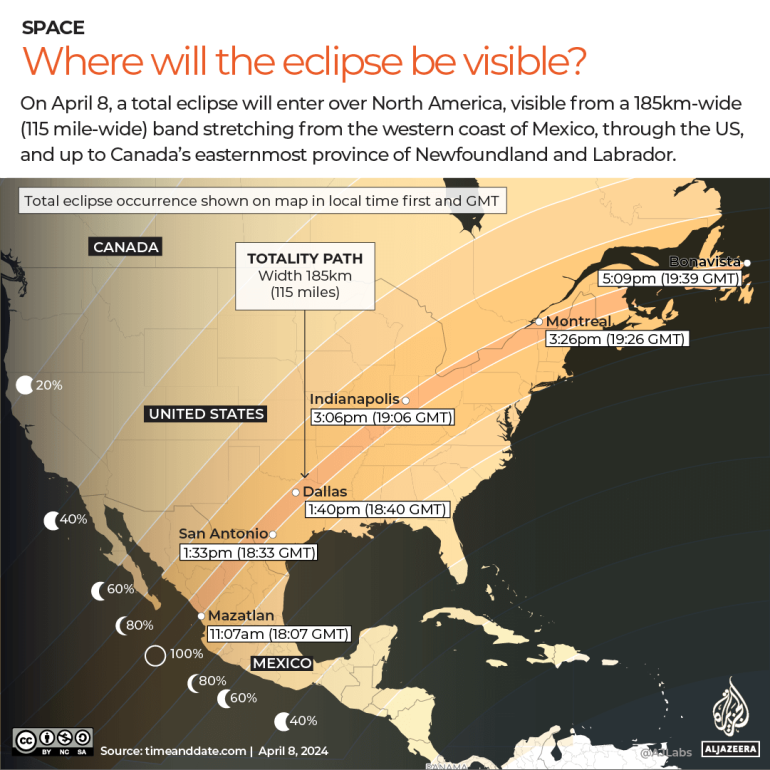
It will be visible from a 185km-wide (115 mile-wide) band that stretches from the western coast of Mexico, through the US, and up to Canada’s easternmost province of Newfoundland and Labrador – what’s known as the “path of totality”.
“Weather permitting, people along the path of totality will see the sun’s corona, or outer atmosphere, which is usually obscured by the bright face of the sun,” NASA says on its website.
The path of totality is really “where it’s at” on Monday, said Anthony Aveni, professor emeritus at Colgate University in New York and author of the book, In the Shadow of the Moon: The Science, Magic, and Mystery of Solar Eclipses.
“It’s that precious three minutes or so … of totality when you see a whole range of phenomena that you just don’t see in everyday life,” he told Al Jazeera. “It takes your breath away and you stop what you’re doing and gawk at nature.”
So how often do total solar eclipses occur? How long does it typically last? Where and how can you watch safely? Here’s everything you need to know.

Where will the total eclipse be visible from, and at what time?
Monday’s total eclipse will be visible from parts of Mexico, the US and Canada.
It will enter continental North America in Mazatlan, in the northwestern Mexican state of Sinaloa, at 11:07am local time (18:07 GMT). It will exit the continent on the Atlantic coast of Newfoundland, Canada, at 5:16pm local time (19:46 GMT).
In the US, the eclipse will enter the state of Texas at 1:27pm local time (18:27 GMT) and exit in Maine at 3:35pm local time (19:35 GMT).
It will last only a few minutes, and the exact time it will be visible depends on where you are within the path of totality.
For example, in Erie, Pennsylvania, totality starts at 3:16pm local time (19:16 GMT) and ends at 3:20pm (19:20 GMT).
It will reach Buffalo, New York, a few minutes later: there, totality starts at 3:18pm local time (19:18 GMT) and ends at 3:22pm (19:22 GMT).
A partial eclipse also will be visible for about two hours on Monday, before and after totality.
What happens during a total solar eclipse?
While the Earth and moon both orbit the sun, the moon also circles the Earth each month.
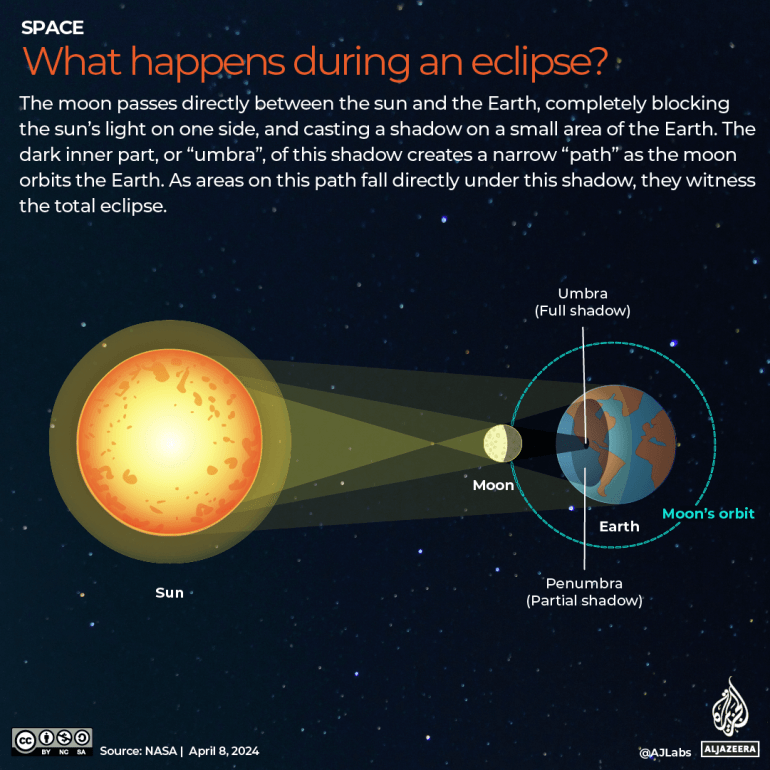
During a total solar eclipse, the moon passes directly between the sun and the Earth, completely blocking the sun’s light on one side, and casting a shadow on a small area of Earth on its other side.
The dark inner part – the “umbra” – of this shadow creates a narrow track or “path” as the moon orbits the Earth. Areas on this path, and especially on its centreline, which fall directly under the shadow, are the ones from where the total eclipse will be visible.
This track is about 160km (100 miles) wide and 16,000km (10,000 miles) long.
“If it was a lunar eclipse, it would last for a few hours and people around the world could see it. But the difference is that total eclipses only happen over a specific path of that new moon,” said Khady Adama Ndao, a NASA eclipse ambassador.
This eclipse only occurs during a new moon. And the moon’s position in its orbit, relative to the sun and Earth, as well as the angles of all three at a specific time, are what create a total eclipse.
While the moon will be close enough to Earth so as to look as though it entirely covers the sun during an eclipse, in reality the moon is 400 times smaller than the sun. It’s the increased distance between the moon and the sun at the time of a total eclipse that makes the moon look like it is big enough to cover the sun.
Meanwhile, people who are close to the path of totality, but not directly in it, may see what’s known as a partial eclipse on Monday. That’s when only a part of the sun is obscured by the moon.
Areas from which a partial eclipse will be visible fall under faint parts of the moon’s wider shadow, called the “penumbra”.
What does a total eclipse look like?
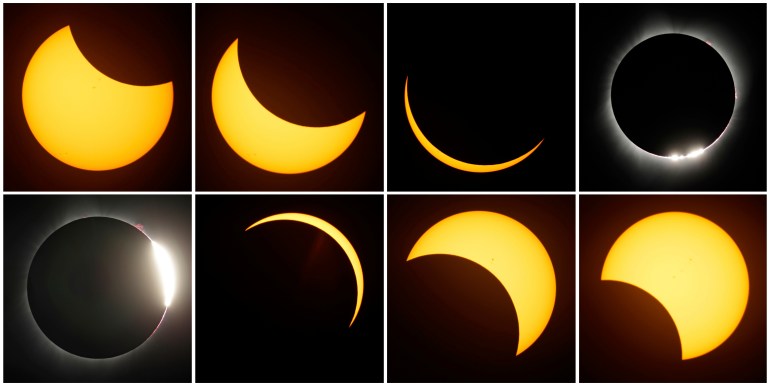
As the moon moves past the sun during an eclipse, it will slowly obscure the sun – creating a dark sky – before reaching the moment of “totality”. That’s when almost the entirety of the sun will be covered, leaving only a faint circle of the sun’s light or the corona.
After a few minutes, people in the path of totality will see a partial eclipse again as the moon moves away. The sun will become fully visible again.
What else happens during the moment of totality?
There is a drop in temperature and animals also start to behave as if it’s nighttime.
The chirping patterns of birds may change, while nocturnal animals such as bats and owls may start to wake up and look for prey.
Stars and celestial objects hanging in the dark sky may also become more visible.
If a person were to stand on the moon or a space station orbiting Earth, they would also be able to see a dark shadow passing over the Earth.
How long will the total solar eclipse last on April 8?
A total solar eclipse can last between two to three hours, from the moment the moon first begins to cover the sun, until the time the moon crosses past the sun and stops obscuring it.
However, the period of totality in most places this year will last only between three and a half to four minutes.
Areas on and very close to the centreline will experience the longest period of totality while totality will last for shorter periods of time in areas farther from the centreline.
The longest period of totality on Monday – 4 minutes and 28 seconds – will occur near Torreon, Mexico. That’s because the area is closest to the point at which the shadow’s path is perpendicular to the Earth’s surface and near the central line of the umbral shadow.
In the past, totality in some places has lasted for as little as a few seconds, and as long as seven and a half minutes.
The durations of the eclipse and the period of totality differ due to a combination of factors, such as the curvature of the Earth and angle at which the moon’s shadow strikes.
Mobile applications such as “Totality” track eclipse start and end times, as well as totality durations for different cities on the total eclipse’s path.
What are among the cultural and historic beliefs round whole photo voltaic eclipses?
Complete photo voltaic eclipses have captivated individuals for 1000’s of years. However in historic civilisations, the phenomenon was usually considered as a nasty omen.
In historic China, for instance, individuals believed that photo voltaic eclipses occurred as a result of “a celestial dragon” was consuming the solar, in accordance with NASA. In consequence, individuals made loud noises throughout eclipses “to frighten the dragon away”.
The Inca individuals of South America believed photo voltaic eclipses have been an indication of the solar god Inti’s anger.
And in historic Mesopotamia (modern-day Iraq), a photo voltaic eclipse was thought to sign that the ruler was in grave hazard – main decision-makers to place a system in place often known as the “substitute king”.
To be able to forestall the true Assyrian king, for instance, from being harmed, a substitute could be dressed up and finally provided as a sacrifice “for the evil destiny that was destined for the true king”, defined Sarah Graff, a curator within the Division of Historical Close to Jap Artwork on the Metropolitan Museum of Artwork in New York Metropolis.
In response to Aveni at Colgate College, there’s a tendency to view individuals previously as being much less clever or extra superstitious about eclipses than individuals at the moment. “However in each case, it’s an event to have a dialog,” he informed Al Jazeera.
As an illustration, individuals made noise within the historic Andean world throughout an eclipse “to alert the solar to not consider what the moon is whispering in his ear, which is that we people who dwell down right here on Earth do unhealthy issues at night time”, Aveni stated. “This turns into an event to have a dialogue about mendacity – that’s actually what it’s about.”
Are you able to watch a complete photo voltaic eclipse with out glasses?
Specialists stress that security is vital.
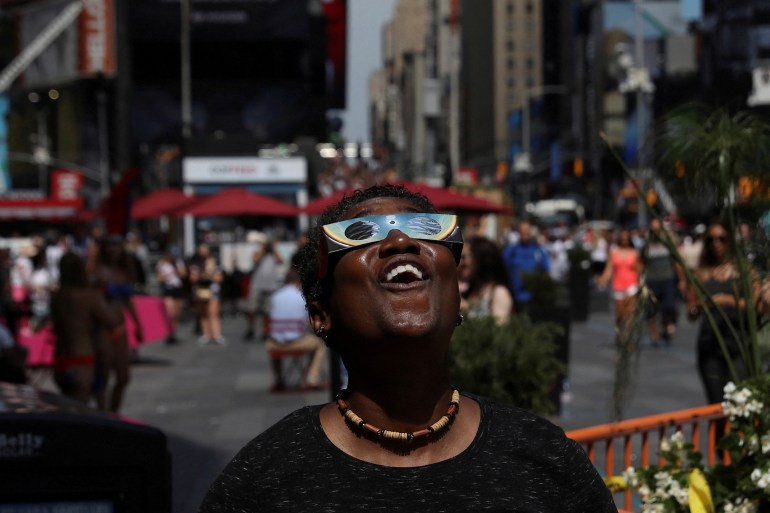
Through the temporary time through which the moon utterly blocks out the solar, individuals can view the entire eclipse with their bare eye.
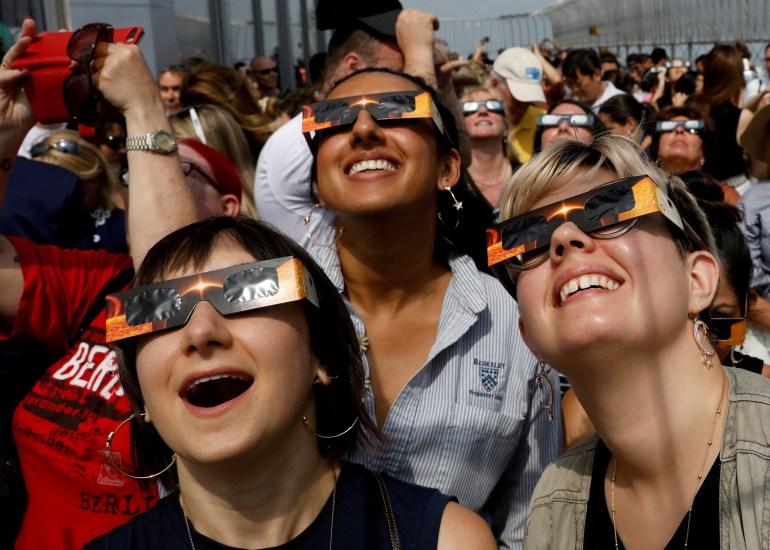
However through the partial eclipse earlier than and after totality, you need to use specifically designed, protecting photo voltaic glasses or a handheld photo voltaic viewing machine.
“If individuals look with out the right safety, they run the chance of injuring their eyes,” stated B Ralph Chou, president of the Royal Astronomical Society of Canada.
“And in the event that they get an harm, relying on how usually and the way lengthy they have a look at the solar with out the safety, they do have a considerable danger of growing a everlasting lack of imaginative and prescient.”
This danger is because of various components such because the depth and radiation of the solar’s gentle, in addition to the absence of ache receptors within the eye, which makes it simpler to stare for too lengthy.
In contrast with an everyday day, pupils can also be much less dilated throughout an eclipse, making the brilliant gentle that enters extra harmful. “It’s like being at midnight, when impulsively, somebody simply flashes a flashlight in entrance of your eyes”, Ndao, the NASA eclipse ambassador, stated.
How are individuals making ready?
Cities and cities throughout the trail of totality have been distributing eclipse glasses to residents within the weeks main as much as Monday’s occasion. Museums, science centres and different establishments are holding viewing events.
Faculties within the US and Canada have introduced closures on Monday to permit college students to take part in eclipse-watching occasions. The closures additionally purpose to keep away from questions of safety, as faculties have raised considerations that the entire eclipse coincides with faculty dismissal instances.
Teams of individuals are additionally flying in personal planes to look at the totality, stated Barbara Gruber, assistant director of training and public outreach on the Nationwide Radio Astronomy Observatory (NRAO) within the US.
Whereas that is permitted, the US Federal Aviation Authority has put out security advisories about flying throughout totality.
Are you assured to see the entire eclipse when you’re within the path of totality?
Sadly not. Climate situations will play an vital consider what hopeful eclipse-watchers will be capable to see on Monday.
In different phrases, if it’s cloudy, that would break the visibility.
For those who’re not in North America, a number of establishments will probably be internet hosting dwell protection of the entire eclipse, together with NASA.
How usually does a complete photo voltaic eclipse occur?
Whereas Monday will be the final time the US sees an eclipse for at the very least one other 9 years, a complete photo voltaic eclipse typically happens each 18 months.
Many whole eclipses are solely seen at sea and might not be seen by anybody in any respect, in accordance with Ndao.
Moreover, as soon as a specific space experiences a complete eclipse, it might not see the return of the phenomenon for a whole lot of years.
“On common a single location will expertise a complete photo voltaic eclipse about each 350 years, however averages might be deceptive and a few fortunate locations will get an eclipse in just some years”, Gruber informed Al Jazeera.
When is the subsequent whole photo voltaic eclipse?
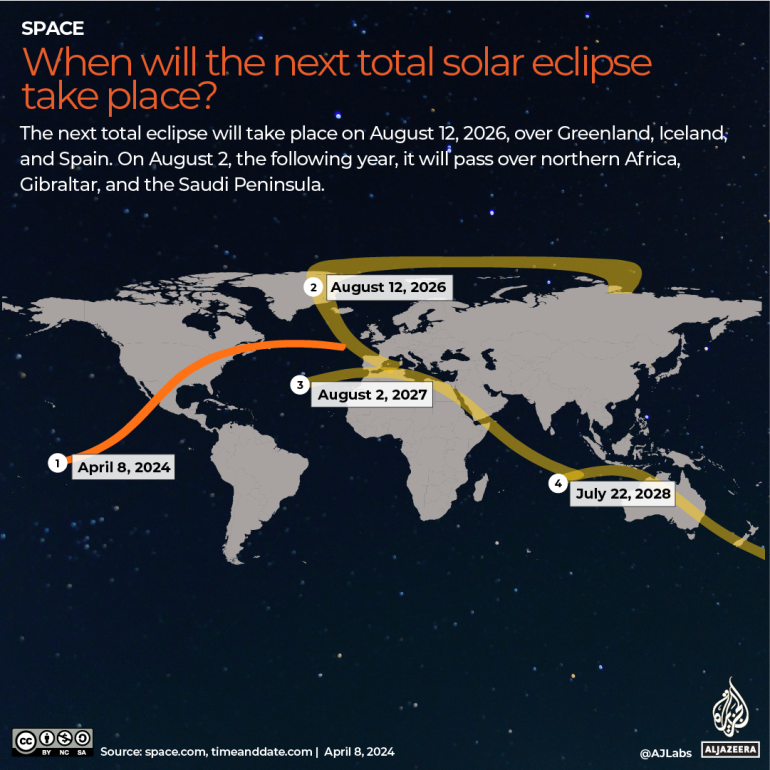
The subsequent whole photo voltaic eclipse will happen on August 12, 2026, over Greenland, Iceland, and Spain. Virtually precisely a 12 months later, on August 2, 2027, one will probably be seen from northern Africa, Gibraltar, and the Saudi peninsula.
Within the US, the subsequent whole eclipse will happen in 2033 however will solely be seen from Alaska.
Western Canada, Montana and North Dakota will witness a complete eclipse in 2044 and, the next 12 months, individuals within the US will be capable to see a complete eclipse from coast to coast, in accordance with NRAO.
Specialists say a day will come, nonetheless, when whole eclipses will cease occurring altogether – however not for fairly some time.
Because the universe expands with the moon shifting additional away from the Earth every year, and the solar will get larger, the moon will ultimately turn out to be too small within the sky to dam the entire solar.
That day continues to be a distant actuality although. A NASA examine in 2017 estimated that whole eclipses would finish in 563 million years.